About Hegman Gauge
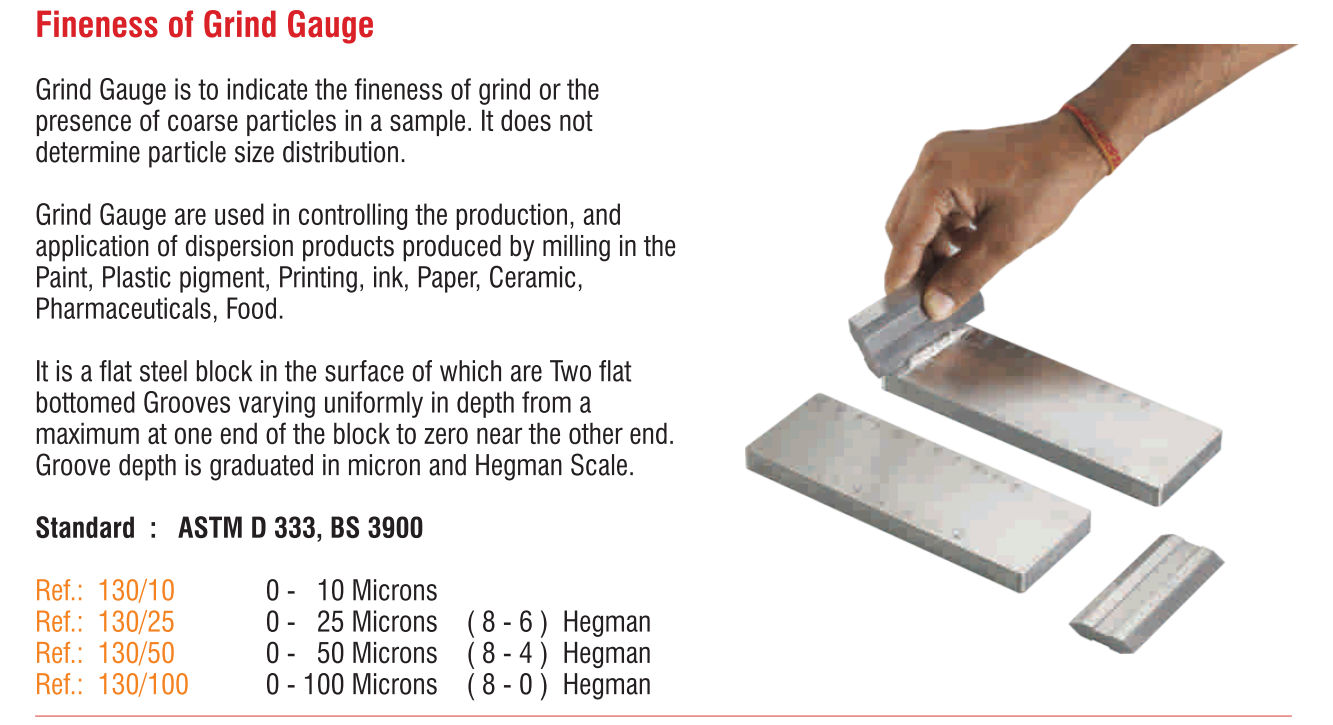
AHegman gauge, sometimes referred to as agrind gauge,grind gage, or grindometer, is an instrument which indicates the fineness of grind or the presence of coarse particles and agglomeration in adispersion.[1]It is commonly used to determine how finely ground the particles ofpigment(or other solid) dispersed in a sample ofpaint(or other liquid) are. This is important because many types of solid materials must be ground into finer particles in order to be dispersed in liquids.[2]The resulting properties of the dispersion vary based on the size of individual particles and the degree which they are dispersed.
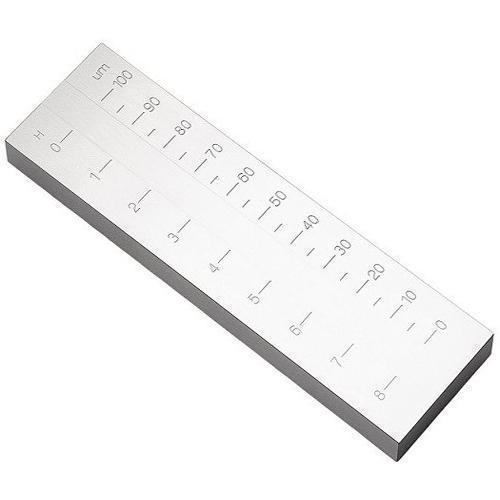
The Hegman gauge usually consists of a stainless steel block with a series of very small parallel grooves machined into it. The grooves decrease in depth from one end of the block to the other, according to a scale stamped next to them. A typical Hegman gauge is 170mm by 65mm by 15mm, with a channel of grooves running lengthwise, 12.5mm across and narrowing uniformly in depth from 100 m to zero and used to determine
A Hegman gauge is used by placing a sample of paint at the deep end of the gauge and drawing the paint down with a flat edge along the grooves. Grind gages are sold with machined flat drawdown bars specifically for this purpose. The paint fills the grooves, and the location where a regular, significant "pepperyness" in the appearance of the coating appears, marks the coarsest-ground dispersed particles.[3]This is the point where oversized particles start to appear in high density and determines the rating for that material.[4]The reading is taken from the scale marked next to the grooves, in dimensionless "Hegman units" (orNational Standardunits; NS) and/ormilsormicrometres.[5]Hegman units are defined in terms of an inverted size scale as shown below:[6]
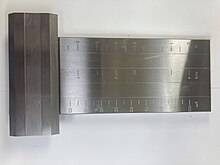
Hegman Grind Gage and doctor blade

Paint sample at top of Hegman
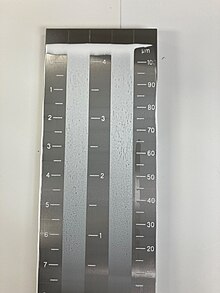
Hegman after paint drawdown
| Hegman Units |
Mils |
Microns |
| 0 |
4.0 |
101.6 |
| 1 |
3.5 |
88.9 |
| 2 |
3.0 |
76.2 |
| 3 |
2.5 |
63.5 |
| 4 |
2 |
50.8 |
| 5 |
1.5 |
38.1 |
| 6 |
1 |
25.4 |
| 7 |
0.5 |
12.7 |
| 8 |
0 |
0 |
A lesser-used scale, North (or PCU), is also occasionally employed in the paint industry. Like the Hegman scale, this is also inverted compared to the value in microns:
| Microns |
North units |
| 0 |
100 |
| 10 |
90 |
| 20 |
80 |
| 30 |
70 |
| 40 |
60 |
| 50 |
50 |
| 60 |
40 |
| 70 |
30 |
| 80 |
20 |
| 90 |
10 |
| 100 |
0 |
Determining the fineness of a paints grind is important, because too coarse a grind may reduce the paints color uniformity,gloss, and opacity.[7]The Hegman gauge is widely used for this purpose because it requires minimal skill and only a few seconds work.[3]
Versatile Applications Across Multiple IndustriesThe Hegman Gauge is ideal for measuring particle size and dispersion in a variety of sectors including oil refineries, marine engineering, textile industry, chemical processing, petrochemical plants, pharmaceutical manufacturing, mechanical engineering, and nuclear power engineering. Its adaptability ensures reliable performance and enhanced quality control in both industrial and laboratory settings.
Durable Construction and Precise DimensionsManufactured from premium stainless steel, the Hegman Gauge offers outstanding resistance to corrosion and wear. Its silver color and variable width (10-50 mm) accommodate diverse user requirements. With an industrial-grade guarantee, this gauge delivers long-lasting durability and unwavering measurement accuracy.
FAQs of Hegman Gauge:
Q: How is the Hegman Gauge used in oil refineries and chemical plants?
A: In oil refineries and chemical plants, the Hegman Gauge is used to determine the fineness of grind and particle dispersion within various slurries, pastes, and samples, ensuring process efficiency and product quality.
Q: What benefit does the stainless steel material offer for industrial applications?
A: Stainless steel imparts high resistance to corrosion and mechanical wear, making the gauge suitable for demanding environments and offering a longer service life with reliable measurements.
Q: When should the Hegman Gauge be calibrated and maintained?
A: Calibration and maintenance should be conducted regularly as per manufacturer recommendations or before critical measurement tasks, especially in laboratory and high-precision industrial processes.
Q: Where is the Hegman Gauge most commonly used in India?
A: The gauge is widely used across Indian oil refineries, chemical processing facilities, textile factories, pharmaceutical plants, and research laboratories due to its accuracy and dependability.
Q: What is the process for measuring particle size with the Hegman Gauge?
A: A sample paste or dispersion is applied along the gauge; as it is drawn down its graduated scale, the point where particles become visible indicates their maximum size, providing consistent and quantifiable results.
Q: How does using a Hegman Gauge benefit laboratory quality control?
A: It allows lab technicians to quickly assess grind fineness, helping ensure raw materials and final products meet stringent industry standards for quality and consistency.




 Send Inquiry